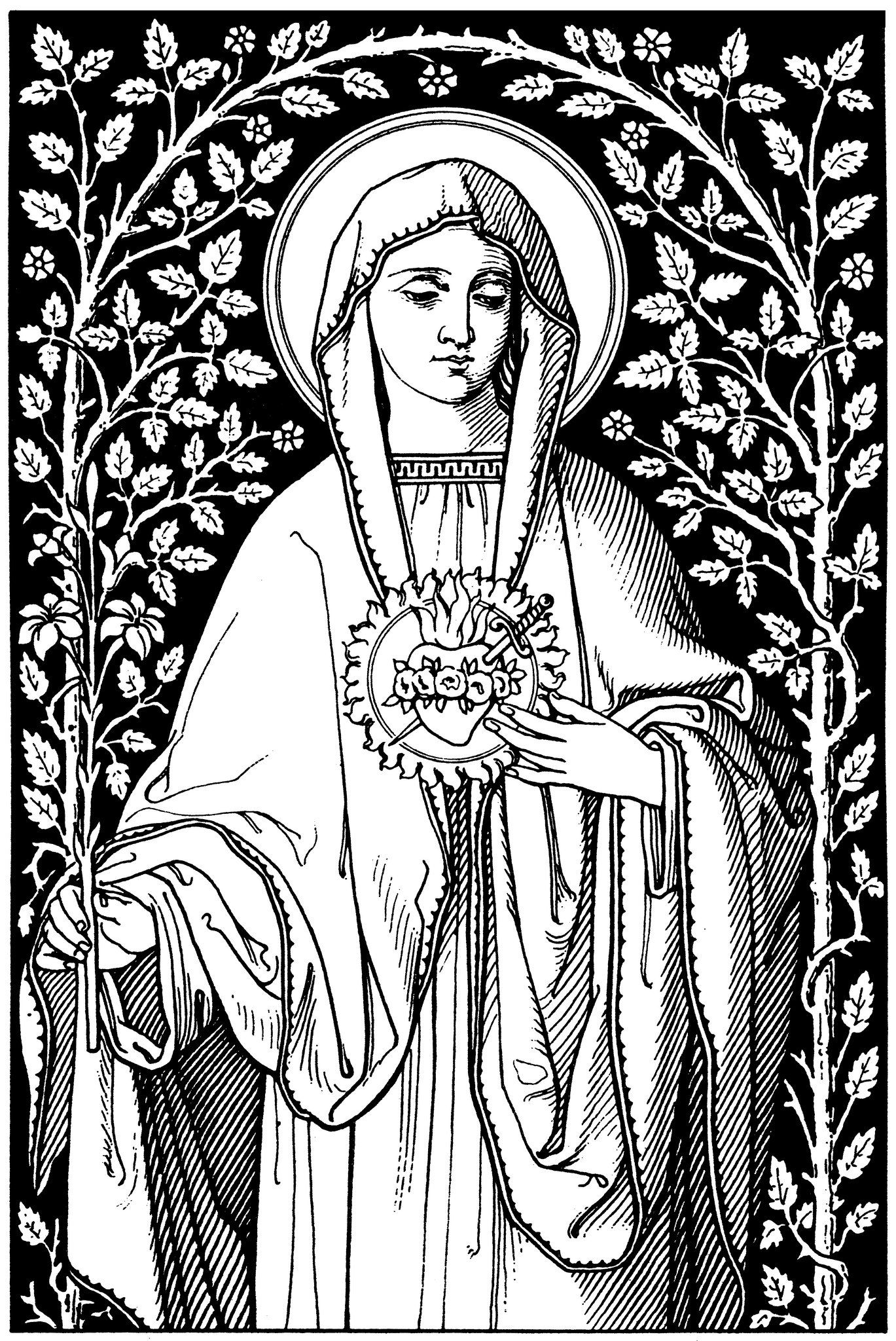
As TM continues his informal dialogue with the Mother of God in his journal entry of July 17, 1956, he introduces the figure of the prophet, Elijah [Elias], before briefly acknowledging having unexpectedly encountered the very One with whom he now converses:
Today … it happened in the refectory that the vocation of Elias to hide at Kerith was read, from the Book of Kings [1 Kings 17]. It just happened to be the time for it today. And I am going to the Woods because it is my day to pray. Before that, I find you here – in prayer. 1
When TM states that “[i]t just happened to be the time for” the reading of the 17th chapter of the First Book of Kings to be read at the meal, it doesn’t really explain the whole context, in that that reading would be have been appointed for the feast day. Our Lady of Mount Carmel was the feast day of the religious order founded in her name, the Carmelites, who include among their ranks such great spiritual figures as Teresa of Avila (1515 – 1582), John of the Cross (1542 – 1591), and Thérèse of Lisieux (1873 – 1897). And the prophet Elias is embraced as the “founder” of the Carmelite Order, since he, for centuries, had been considered as a model for contemplatives because of what TM describes as his “vocation” to “hide at Kerith” in the desert. 2 This would have been of a poignant reminder – and affirmation – to TM, as he himself had realized in the mid-1950’s his own “vocation” to be a “hermit.” 3 These many levels of connection would have made the July 17th feast day resound deeply in TM’s mind and heart.
In his 1955 essay, the Cistercian monk writes of “The Primitive Carmelite Ideal”:
To hide in the torrent of Carith is to embrace the ascetical life, which leads to the perfection of charity by one’s own efforts, aided by the grace of God. To drink of the torrent is to passively receive the secret light of contemplation from God and to be inwardly transformed by His wisdom …. The Carmelite, then, is the successor of the prophets as a witness to the desert vocation of Israel, that is of the Church: a reminder that we do not have on this earth a lasting city, and that we are pilgrims to the city of God. 4
However, as much as Elias can be seen as an ancient prototype of this particular way of holiness, TM very clearly asserts that it is the Mother of Christ who best incarnates its depths:
If Elias stands as the model of all Carmelites, there is another and more perfect figure than that of the prophet: the figure of the Blessed Virgin of Mount Carmel who, even more than Elias, embodies in herself the perfection of the Carmelite ideal. Where in Elias we see at once the zeal and the weaknesses of the prophet, his greatness and his imperfections, his conflicts and his inner contradictions, in Mary we see a sanctity that is beyond prophecy and conflict, hidden in perfect humility and in ordinariness … [T]he example and influence of the Queen of prophets are there to heal these divisions. The sanctity of Our Lady was great indeed, but so great that it cannot adequately be expressed in anything other than the ordinary ways of human existence. In this, as in so many other things, she resembles her Divine Son. Like Him, she was in all things human and ordinary, close to her fellow men, simple and unassuming in her way of life, without drama and without exaltation. 5
It is no doubt because of what he perceives as her intimacy with “the ordinary ways of human existence,” her hidden closeness to all ordinary human beings, and her prayerful and contemplative watchfulness, that TM can end his journal entry with these tender and deeply personal pleas to the Virgin Mother:
I need to be led by you. I need my heart to be moved by you. I need my soul to be made clean by your prayer. I need my will to be made strong by you. I need the world to be saved and changed by you. I need you for all who suffer, who are in prison, in danger, in sorrow. I need you for all the crazy people. I need your healing hands to work always in my life. I need you to make me, as your Son, a healer, a comforter, a saviour. I need you to name the dead. I need you to help the dying to cross their particular rivers. I need you for myself whether I live or die. I need to be your monk and your son. It is necessary. Amen. 6
Endnotes
- Thomas Merton, A Search for Solitude: The Journals of Thomas Merton, Volume Three 1952-1960. Ed. Lawrence S. Cunningham. San Francisco: HarperCollins, 1996, page. 46. In this entry, TM also addresses the Blessed Mother with these words: “Prayer is what you bring – for prayer is rather your gift to us than what you ask of us. If only I could pray – and yet I can and I do pray. Today, for example, it happened in the refectory that the vocation of Elias to hide at Kerith was read, from the Book of Kings [1 Kings 17]. It just happened to be the time for it today. And I am going to the Woods because it is my day to pray. Before that, I find you here – in prayer. And sacrifice then. But teach me what it means. Teach me to go to this country beyond words and beyond names.” (Emphasis, Ibid.) TM’s reference to “sacrifice” recalls the words of another Cistercian, Father Thomas Keating: “Sacrifice is the meaning of this universe. In heaven, the total giving away of all that one has is delightful. In this world, it’s hell.” (Emphasis mine. Father Thomas Keating. “Oneness & The Heart of the World.” Global Oneness Project. Feb 28, 2009, minutes 33:13-33:33. Retrieved from: Father Thomas Keating: Oneness & The Heart of the World – YouTube
- In an essay entitled, “The Primitive Carmelite Ideal,” TM speaks of “the symbolic adoption by the Carmelites of the prophet Elias as their ‘Founder.’” He continues: “It is quite true that the hermits living on the slopes of Mount Carmel, near the ‘spring of Elias,’ where the prophet himself had prayed and dwelt alone, and where the ‘sons of the prophets’ had a ‘school,’ could claim to be descendants of the ancient prophets. It is quite true that Elias, in a broad sense, was the ‘founder’ of this way of life since he had in fact been the inspiration for those countless generations that had lived there in the places hallowed by his memory and stamped with his indelible character.” (Thomas Merton, “The Primitive Carmelite Ideal.” Disputed Questions, San Diego: Harcourt Brace Jovanovich, Publishers, 1960, pages 221-222.)
- For additional context regarding TM’s struggle with living the life of a monk living in a monastic community – a cenobite monk – and his search for deeper solitude in the life of hermit see the chapter, “The Hermit of Times Square,” in Jim Forest, Living with Wisdom: A Life of Thomas Merton. Maryknoll, New York: Orbis Books, 1991, page 111ff. This aspect of TM’s spiritual journey created a sense of tension with the abbatial leadership of Gethsemani. These struggles were enfolding in 1950’s, and thus the editor of his personal journals from 1952 to 1960 entitled the volume, “A Search for Solitude.” In passages from his 1955 essay, “The Primitive Carmelite Ideal,” one can hear a real sense of attraction and longing: “[T]he life itself was left free and informal so that the hermits could do anything that conformed to their ideal of solitude and free submission to the Holy Spirit” (220). “[T]hey could do whatever good work was compatible with a life of which most was spent in the solitude of the cell” (221). Referencing the school or “schola” of the early Carmelites,” TM offers following brief explanation of the Latin term: “Schola not only in the sense of a place one learns, but in the more original and etymological sense of a place of leisure, quiet and retirement, where one can think deeply” (222). (Thomas Merton, “The Primitive Carmelite Ideal.” Disputed Questions, San Diego: Harcourt Brace Jovanovich, Publishers, 1960.)
- Thomas Merton, Disputed Questions, San Diego: Harcourt Brace Jovanovich, Publishers, 1960, pages 225-226). I learned of this latter passage from Patrick F. O’Connell, “The Geography of Solitude: Thomas Merton’s ‘Elias – Variations on a Theme’.” The Merton Annual, Volume 1, New York: AMS Press, 1988, 151-190. I have also benefitted from the insights in Margaret Bridget Betz, “Merton’ s Images of Elias, Wisdom, and the Inclusive God.” The Thomas Merton Annual 13. New York: AMS Press, 2000, pages 190-207.
- Thomas Merton, Disputed Questions, San Diego: Harcourt Brace Jovanovich, Publishers, 1960, page 227. TM also expands his reflections to include how this ideal was incarnated in the lives of great Carmelite Saints: “The mysticism of St. Theresa is rooted in a life of ordinariness and common sense, because it accepts the wholeness of human nature just as it is. The doctrine of St. John of the Cross goes to the greatest lengths to exclude everything that savors of heroic show and mystical display, discarding all visions, revelations, locutions and ecstasies in favor of ‘dark faith’ …. The ‘little way’ of St. Theresa of Lisieux is predominately a Marian way. The whole spirit and ideal of Carmel is, at least implicitly, a re-living of that great mystery of faith in the Blessed Virgin who was ‘blessed because she believed’ (Luke 1:45) and who, by her faith, brought the Lord of Majesty into the world in human form. It can be said that the Carmelite spirit is essentially a ‘desert’ spirit, a prophetic ideal. And that Elias represents the exterior, the more material aspect of the ideal. But that the Virgin Mary is the symbol and source of the interior spirit of Carmel. Which means that in the long run, the desert spirit and prophetic ideal of Carmel are understood most perfectly by those who have entered into the ‘dark night’ of Marian faith.” (Thomas Merton, “The Primitive Carmelite Ideal.” Disputed Questions, San Diego: Harcourt Brace Jovanovich, Publishers, 1960, pages 227-228.)
- Thomas Merton, A Search for Solitude: The Journals of Thomas Merton, Volume Three 1952-1960. Ed. Lawrence S. Cunningham. San Francisco: HarperCollins, 1996, pages 46-47.
 Julian of Norwich and Other Tibetan Lamas
Leave a comment