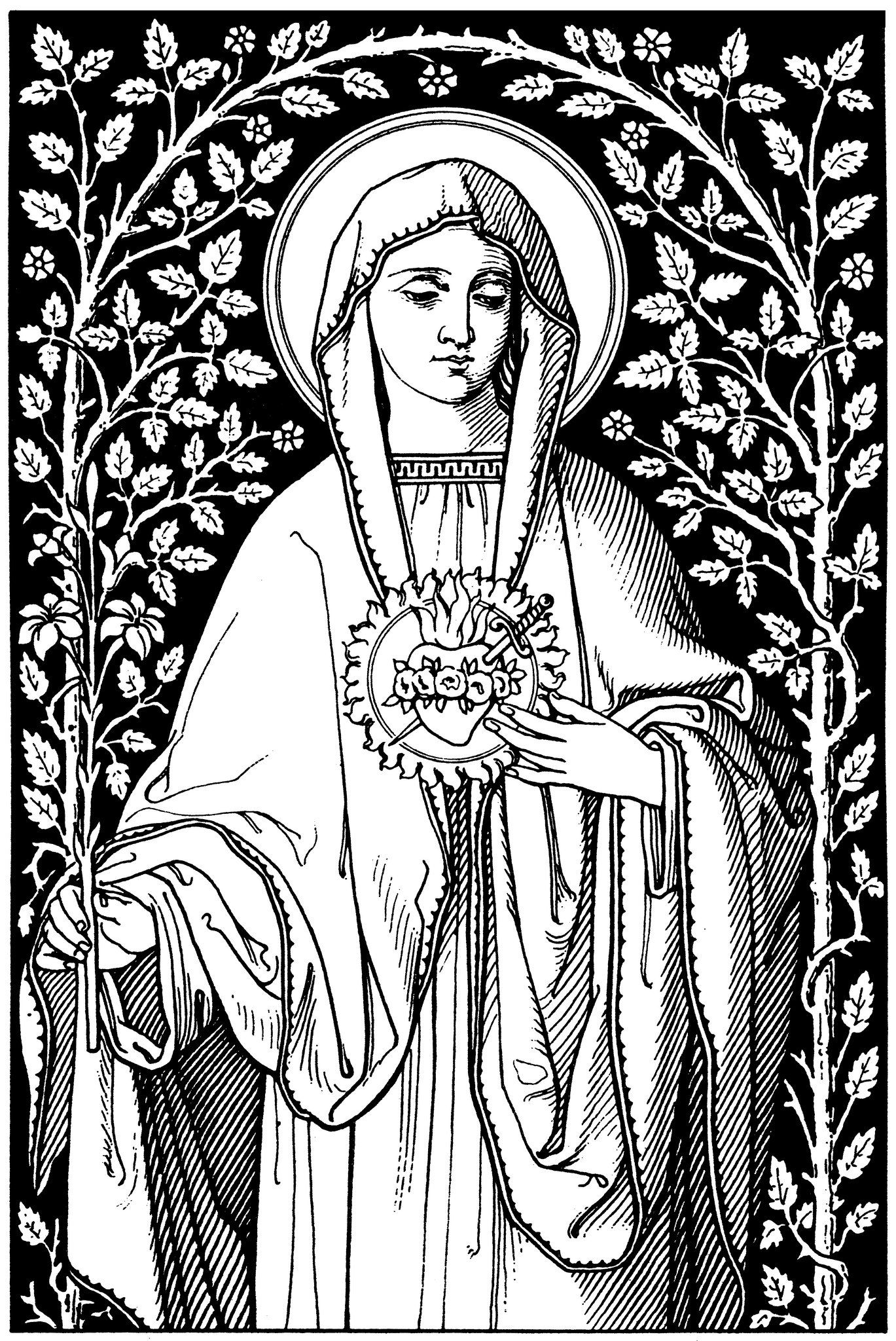
After describing how she saw the blood trickle down from under the garland of thorns, Julian states: “I conceived truly and mightly that it was himselfe that shewed it me, without any meane.” The “himself” refers to the one upon whose “blessed head” the garland of thorns was “pressed,” the one who is “both God and man.” It is, as the anchorite affirms, “the same that sufferd for me.” 1
The Middle English Dictionary defines “meane” or “mene” as “an intermediary, negotiator, go-between; a spokesman, a representative,” and within religious discourse, “of Christ, as meditator between God and man; of the Virgin Mary, saints: intercessor, advocate, helper.” 2 And indeed, the Virgin Mother of Jesus was the primary “meane” through medieval Christian approached the Divine. One can hear such recourse over and over again in the prayers of the period:
I pray thee, lady, the moder of Crist, / Praieth youre sone me for to spare / With al angels, and John Baptist, / And all youre company that now ys thare. / Al holichurch, for my welfare, / Graunt me of youre merites a participacioun, / And praieth oure Lorde for my salvacyon. 3
Another lyric begins by bidding the intercessory prayers of the Virgin, addressing her as “tryclyn,” from the Latin, “triclinium,” meaning a dining table with couches on three sides: “O tryclyn of the Trinité, / Replete with alle divinité, / O flowre of alle virginité, / Ora pro nobis.” The same piece ends with a request for prayers that the soul, at the end of its earthly pilgrimage, may arrive in heaven: “Thatte we, which be terrestrialle, / May leve this lyff so bestialle / And come to blysse celestialle, / Ora pro nobis.” 4
The hope and the trust that medieval Christians had in the capacity of the Virgin Mother to be their Advocate finds something of its source in the manner in which occupies a space “between.” Clare Marie Snow writes: “Mary embodies liminal status: she bridges the gap between binaries of human and divine, virgin and mother, sister and spouse, life and death, flesh and spirit.” 5 And in a religious culture in which Christ himself was understood as doomsman and judge, who was portrayed as not without a fierce wrath, the mediating position and presence of the Blessed Mother was a deep comfort:
Mary, modur of grace, we cry to thee, / Moder of mercy and of pyté, / Put us fro the fendes fondying, / And help us at oure last endying, / And to thi sone oure pes thou make, / That he of us no wreke [vengeance] take. / To yow I cri wyth mylde steven [voice], / All the halowes that are in heven … 6
A story in the Gesta Romanorum, about a woman who turned from sin, conveys the belief and the devotion. One day the woman, who had seemingly reached a point of exhaustion with the way her life was going, decided to follow a sizable group of people into a church to learn what goes on within that space: “I wil go wete [know] what this folke do there.” Not long after she entered and sat down with the others, someone went into the pulpit and began to preach. And, the narrator explains, “his sermone was mych of the mercy of god …” In response to this sermon, the woman experienced deep contrition, wept, and decided that she would confess. And thus, she did, to the cleric who offered the sermon. He “herde here life,” and afterwards said to her:
‘[D]oughter … be not a-ferde, for thou shalte fare right wele. go to yondere autere, and knele downe be-fore oure ladie, and pray here hertly and deuoutely, that she wolde be goode meane to here sone; for she is all weye modre of mercy, and remedie for to helpe.’ 7
Endnotes
- Julian of Norwich, The Writings of Julian of Norwich, Eds, Nicholas Watson and Jacqueline Jenkins. University Park, The Pennsylvania State University Press, Chapter 4, lines 1-5, page 135.
- “mene,” Middle English Dictionary at Middle English Compendium: mene – Middle English Compendium (umich.edu)
- “I pray thee, lady, the moder of Crist,” Middle English Marian Lyrics. Edited by Karen Saupe. Kalamazoo, Michigan: Medieval Institute Publications, 1997, lines 1-7, #54. Online: Mary Mediatrix | Robbins Library Digital Projects (rochester.edu)
- “Sancta Maria, ora pro nobis,” Middle English Marian Lyrics. Edited by Karen Saupe. Kalamazoo, Michigan: Medieval Institute Publications, 1997, lines 1-5, #56. Editor Karen Saupe notes that “triclinium” references the Virgin’s sacred role as “chamber of the Trinity.” The use of the word “triclinium” in reference to the Virgin Mary can be found in the hymn by Adam of St. Victor (c.1100-c.1146): “Salve mater pietatis / Et totius trinitatis
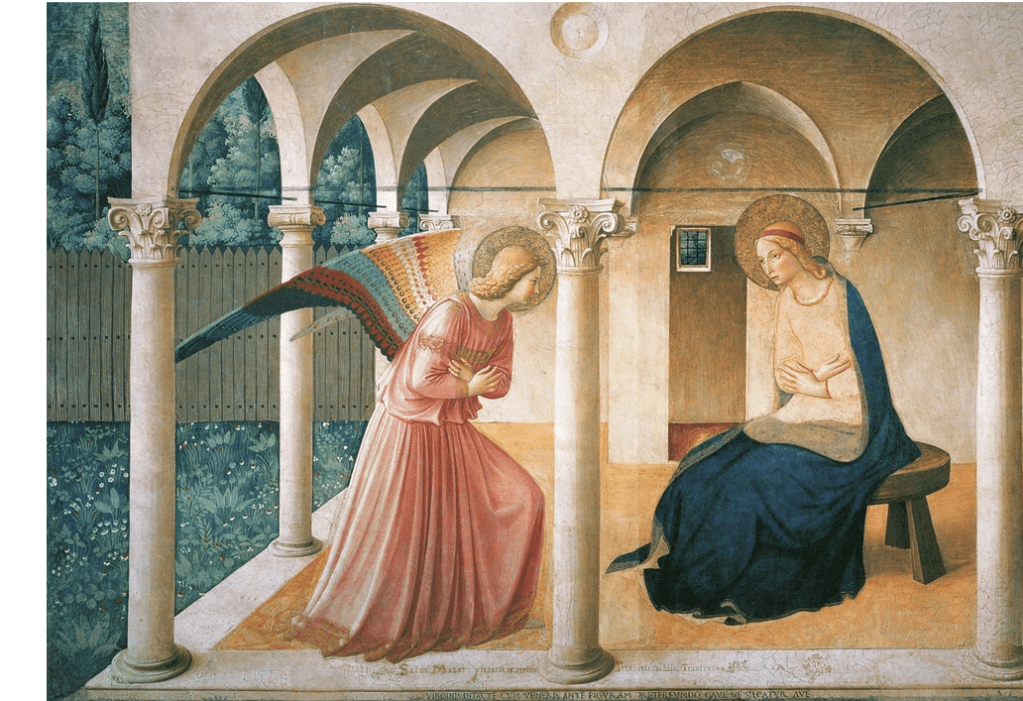
Nobile triclinium, / Verbi tamen incarnati / Speciale maiestati / Praeparans hospitium.” English: “Hail, Mother of Compassion and noble chamber of the whole Trinity, preparing a special lodging for the majesty of the word made flesh.” “Tu thronus es Salomonis,” Motet Cycles Database: T015 Tu thronus es Salomonis | Motet Cycles Database The words “Salve mater pietatis / Et totius trinitatis / Nobile triclinium” are included as an inscription – between the front columns – in “The Annunciation” of Fra Angelico (1395-1455). (“Fra Angelico, The Annunciation.” Christian Iconography: The Annunciation, Fra Angelico (christianiconography.info) The image below of Fra Angelico’s work was retrieved from Wiki Commons. - Clare Marie Snow, Maria Mediatrix: Mediating the Divine in the Devotional Literature of Late Medieval England. Dissertation. Centre for Medieval Studies, University of Toronto, 2012, page 14.
- “Mary, modur of grace, we cry to thee,” Middle English Marian Lyrics. Edited by Karen Saupe. Kalamazoo, Michigan: Medieval Institute Publications, 1997, lines 1-7, #65.
- Alistair Bennett, “Gesta Romanorum.” The Encyclopedia of Medieval Literature in Britain. Hoboken: John Wiley & Sons, 2017, page 391. Corpus of Middle English Prose and Verse: Early English versions of the Gesta Romanorum / edited by Sidney J.H. Herrtage (umich.edu)
 Julian of Norwich and Other Tibetan Lamas
Leave a comment