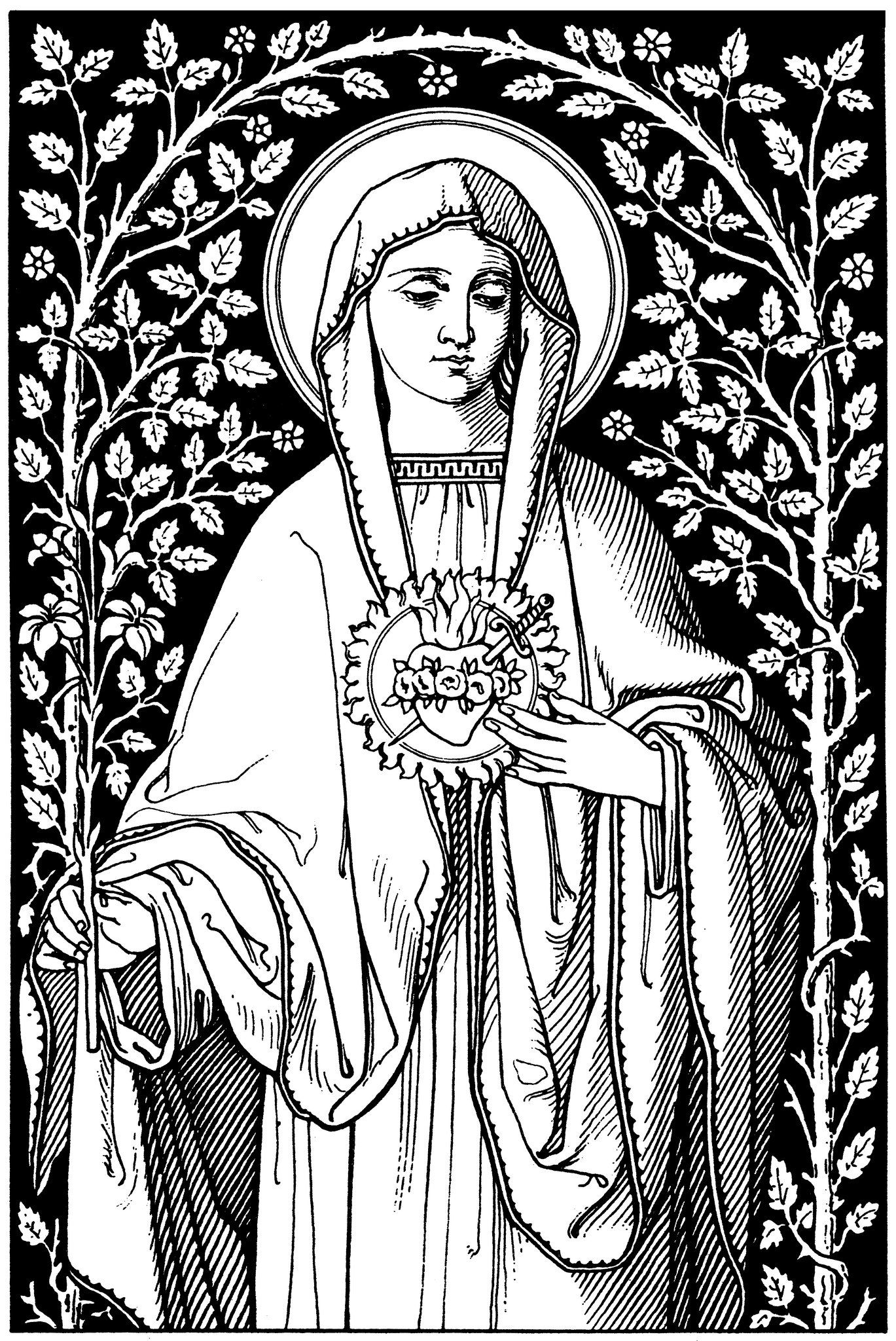
Mary, the Mother of Jesus, was a model of compassion for medieval Christians. The depiction of her standing at the foot of the Cross, seeing the suffering and death of her Son, was certainly central to such devotion. And what happened between Mother and Son on Calvary came to be explained as Jesus suffering his passion in this body and Mary suffering her com-passion in her heart – spiritually. However, the relationship between body and spirit in this tradition was more complex, and less cleanly and clearly defined, than that. Because of the unique circumstances of Jesus’ conception, the body which with he suffered his passion was something he received from his Mother, and thus, that body was, in a sense, an extension of hers, or, it could even be said, at least partially hers.
There is a story in the Middle English translation of the Gesta Romanorum that provides insight in the corporeal relationship between Mother and Son. 1 The story can also serve as a helpful window into medieval understandings of sickness, death, judgement, and the roles of Jesus and Mary in those processes. And the story begins with a man who lived quite sinfully and could/would never amend his ways, regardless of what his confessor or anyone would say or suggest to him. Then Jesus “cast” a sickness on him that caused him to be bedridden for seven years. After that long period of illness, Jesus healed him, so that he might at least get out of bed and walk with a staff, and so he did for another seven years. But he did not utilize that experience to change his life. Then Jesus cast him down again, into his bed, with a sickness greater than the first one. And so, he lay stricken for another seven years – and with no amendment of life. And when those seven years were ended, Jesus made the man as whole and well as ever he was before. The man was certainly glad about this change, and yet he did not leave his sinful ways, and actually, he was more sinful and intractable than he had ever been before. And when he had lived in this way for a while, and would not amend his way of life, the Lord sent a sickness, in which the man lay for three weeks, after which he died. Then the Devil took the man’s soul and led it to a fair level place, in which sat a fair man as Doomsman, on a little hill. And beside the Man there was a fair Lady, and many other Saints, to whom the Devil said, “Rightful Doomsman, judge this soul to dwell with me in hell, for he has lived all his life in sin, and he died therein. For you yourself say, ‘Whoever dies in mortal sin, should go to hell.” Then the soul said, ‘Ah! Lord, have mercy on me.’ Then our Lord said, “Son, I sent the sickness and disease, for you to amend your life, and leave your sin while you lived. But you would not. Therefore, my righteousness wills not that you be saved.’ The man said ‘Ah! Truly, Merciful Lord, have mercy on me!’ “No,” he said, “Now is no mercy, but all righteousness. Therefore, you must be damned.” When the soul heard this, he turned to that blessed Lady, God’s Mother, with reverence and plenty of tears, and said, “Merciful Lady, grace, help, and mercy have been with from the moment of your birth. And therefore, it belongs to your office for to help, and to make satisfaction [a-sethe] for sinful souls. 2 For you are Mother of Mercy, and Maiden most gracious of all Maidens. For it belongs to all Maidens to have pity [ruthe] and compassion. Therefore, Lady, I beseech you for help, that I be not damned.” Then, this Blessed Lady rose, and went and knelt before her Son, and said, “I pray you, Son, have mercy on this soul.” Then said Our Lord, “Mother, I shed my blode for his soul, and of this he would take no heed, nor would he keep my bidding. Therefor, he is worthy to be damned.” “Ah! My Noble Son,” she said, “I know well that you shed your precious blood for him, and all the sinful. But, Son, you know well that that blood was first mine before it was yours, for that blood you received from [toke of] me in your Incarnation. Therefore, Son, give me a portion of mine [parte of myn.] Then, the Good Lord, said again to his Mother, “I can not deny you of what you ask. Therefore, take the soul, and put it into the body again, so that he may live three days. And if he will amend himself, he shall be saved.” Then, our Lady again put the soul into the body. And when the man was alive again, he sorrowed, he sobbed, he wept, he sent for his confessor. And with a sorrowful and contrite heart, he confessed [shrove of] all his sins that might come to his mind, and asked God mercy for them, and for all others that did not come his mind, and he was absolved [assoyled], and took his penance, and did it with great contrition. Afterwards, people came to him to comfort him, and they asked him how he was doing [fared], and how it was with him. Then, he told them how Our Blessed Lady had delivered [delyuered] him from damnation and brought the soul to the body – “that I might amend myself [should amende me], and after the three days go to heaven [go the waye to heuyn].” 3
Endnotes
- “The Gesta Romanorum, a collection of moralized, fictional narratives linked to the emperors of Rome, survives in over 350 manuscripts from the fourteenth and fifteenth centuries. Originally written in Latin, the Gesta was translated into many European languages … The original author of the text and the precise date of composition are unknown, and scholars have debated whether the collection was first produced in England or Germany. The earliest surviving text of the Gesta … dates from 1342 …. The Gesta may well have been intended as a resource for preachers who would incorporate its stories into their sermons to develop and illustrate points of Christian doctrine or morality. Surviving Latin and Middle English sermons use stories from the Gesta in this way and selections from the Gesta are compiled in many manuscripts with cycles of sermons and other material that would be useful for preaching.” (Alistair Bennett, “Gesta Romanorum.” The Encyclopedia of Medieval Literature in Britain. Hoboken: John Wiley & Sons, 2017.)
- Ritamary Bradley observes: “The Middle English Dictionary lists multiple instances in which ‘asseth’ means satisfaction, understood as a component of penance enjoined on the sinner. It is in this sense that satisfaction is a part of penance, together with contrition and confession, in Chaucer’s Parson’s Tale. All three parts are activities on our part. Usage contemporary with Julian also employed the word to signify satisfaction or atonement made by Christ to the Father for human sin.” (Ritamary Bradley, “Julian of Norwich: Everyone’s Mystic.” Mysticism and Spirituality in Medieval England. Edited by William Pollard and Robert Boenig. Cambridge: D. S. Brewer, 1997, page 144). The Middle English Dictionary also lists the word’s usage here in the Middle English Gesta Romanorum as referencing “intervention by the Virgin Mary.” See “asseth” in Middle English Dictionary at Middle English Compendium: asseth – Middle English Compendium (umich.edu)
- The Early English Versions of the Gesta Romanorum. Edited by Sidney J. H. Herrtage. London: N. Trübner & Co, 1879, pages 404-406. Emphasis mine. The retelling in this post of the story, “How the Virgin Pleaded for a Sinner’s Soul,” is a rough translation of the Middle English text as found in Mr. Herrtage’s edition which can be found online at the Corpus of Middle English Prose and Verse: Early English versions of the Gesta Romanorum / edited by Sidney J.H. Herrtage (umich.edu)
Posted on the Feast of Our Lady of Sorrows: “Stabant autem iuxta crucem Iesu mater eius …” John 19.25a
 Julian of Norwich and Other Tibetan Lamas
Leave a comment