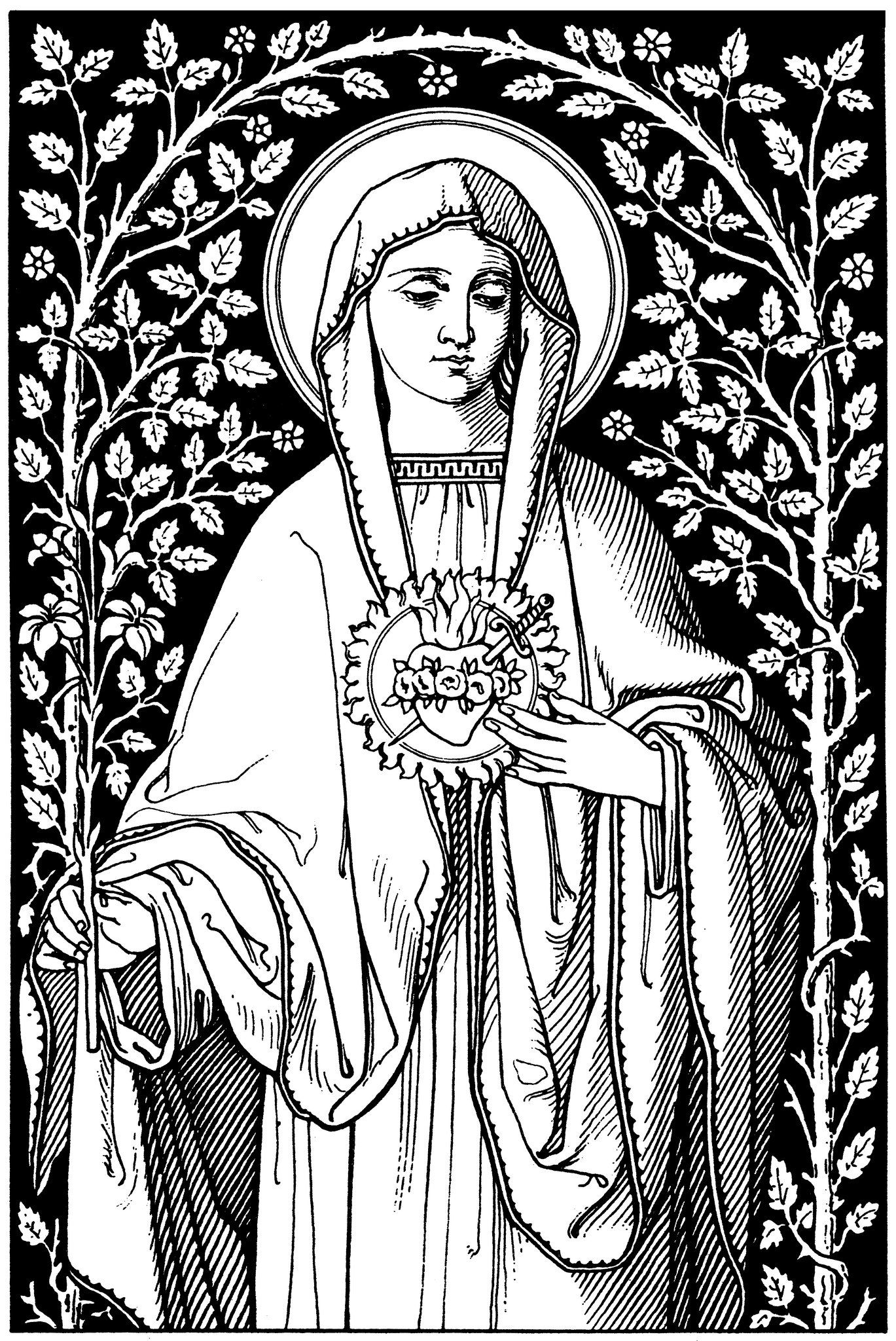
Julian begins the last section of Chapter 3 with the words: “Then cam sodenly to my mind that I should desire the second wound of our lords gifte and of his grace.” 1 These words refer back to the end of Chapter 2, when Julian prays for “thre woundes,” which, in the Short Text, she associates with “the storye of Sainte Cecille.” 2 This second “wound” is that of “kind compassion.” 3 In Chapter 2, the anchorite had written:
[M]ethought I had sumdele feeling in the passion of Christ, but yet I desired to have more, by the grace of God. Methought I woulde have ben that time with Mary Magdaleyne and with other that were Christus lovers, that I might have seen bodily the passion that our lord suffered for me, that I might have suffered with him as other did that loved him. And therefore I desired a bodely sight, wherein I might have more knowinge of the bodily paines of our saviour, and of the compassion of our lady, and of all his true lovers that were living that time and saw his paines. For I would have be one of them and have suffered with them. 4
Early in Chapter 3, Julian describes the physical affliction she experienced due to her illness, and now, at the end of that chapter, she writes of her desire for compassion with an added dimension:
Then cam sodenly to my mind that I should desire the second wound of our lords gifte and of his grace: that my body might be fulfilled with mind and feeling of his blessed passion, as I had before prayed. For I would that his paines were my paines, with compassion and afterward langing for God. Thus thought me that I might, with his grace, have the woundes that I had befored desired. But in this I desired never no bodily sight ne no maner shewing of God, but compassion, as methought that a kind soule might have with our lord Jesu, that for love would become a deadly man. With him I desired to suffer, living in my deadly body, as God would give me grace. 5
While in the language of Chapter 2 there is an emphasis on compassion as a visionary (“seen,” “sight,” “saw”) and affective (“feeling”) experience, in the passage from Chapter 3 the physicality of compassion would seem to be foregrounded: “that my body might be fulfilled with mind and feeling of his blessed passion …” There would seem to be a desire on Julian’s part to integrate her desire for a compassionate understanding of the “paines” of Jesus passion with the “paines” her own ‘sicknes.” Her illness becomes an opportunity, a practice, a vehicle, through which to suffer “with him.” 6 Vincent Gillespie and Maggie Ross point out that Julian, earlier in the Chapter 3, had expressed her desire to be “deliveryd of this world,” and they summarize various “senses” of the Middle English verb “deliveren” to include “deliverance form bondage, prison or captivity; giving up or relinquishing; and giving birth to.” 7 They thus connect “the labor pains” of Julian’s illness” with such a liberative process. And they further observe that the “compassion Julian receives takes her … into something closer to the Pauline kenotic mind of Christ,” as expressed in the Apostle’s Letter to the Philippians. 8
In his introduction to the theme of compassion in the Mahayanasutralamkara, Professor Nagao writes:
It is beyond my capacity to compare these ideas of compassion developed in Indian Mahayana with that developed in Western or Christian theology … But it seems to me that agapē, God’s love specifically distinguished from the usual type of love or eros, is very near to the Buddhistic karuṇā. As stated in the New Testament (Phil. ii,7), Jesus Christ ‘emptied himself (kenosis), taking the form of a servant,’ and took birth in the world. This is the incarnation of Christ for the purpose of absolving humans from their sins. It occurs through his ‘self-emptying love.’ The Greek term kenosis, emptying, reminds me of the Buddhist notion of śūnyatā, emptiness. 9
The pains and pangs of her illness offer Julian a way through which to experience an enfleshed compassion with the kenotic self-emptying of the Crucified, expressive as it is of the compassionate love of the Incarnation itself. 10 In this way, a note of Nicholas Watson and Jacqueline Jenkins regarding the specific quality of the wound which Julian desires is warmly intriguing and revelatory:
‘Compassion’ is ‘kind,” natural, because Christ’s Incarnation makes him one with human kind, as a result of which all can join in his suffering, as his fleshly relatives, or ‘kin,’ by com-passion. 11
Endnotes
- Julian of Norwich, The Writings of Julian of Norwich, Eds, Nicholas Watson and Jacqueline Jenkins. University Park, The Pennsylvania State University Press, Chapter 3, lines 36-37, page 133.
- Julian of Norwich, The Writings of Julian of Norwich, Eds, Nicholas Watson and Jacqueline Jenkins. University Park, The Pennsylvania State University Press, Section 1, line 36, page 65). Fr. John-Julian, OJN, briefly notes: “Paintings of St. Cecilia were very common on rood screens in East Anglian churches.” (The Complete Julian of Norwich. Edited by Father John-Julian, OJN. Brewster, Massachusetts: Paraclete Press, 2009, note # 13, page 68). Sherry Reames writes: “Cecilia’s feast must have been well-established in Britain even before the Norman Conquest, for it appears routinely in monastic calendars written before 1100, and Aelfric retold her legend in an Anglo-Saxon homily, presumably intended for public reading on this occasion. After the Conquest some of Cecilia’s relics were presented to Winchester Cathedral, and a few churches were dedicated to her, but the principal evidence for her cult in late medieval Britian is found in the Latin liturgical books that give texts for her Office and in the Middle English re-tellings of her legend, including one by Chaucer, which directly or indirectly on the liturgical sources.” (Sherry L. Reames, “The Office of St. Cecilia,” The Liturgy in the Medieval Church. Edited by Thomas J. Heffernan and Ann E. Matter. Kalamazoo: Medieval Institute Publications, 2005, page 219).
- Julian of Norwich, The Writings of Julian of Norwich, Eds, Nicholas Watson and Jacqueline Jenkins. University Park, The Pennsylvania State University Press, Chapter 3, line 35, page 129.
- Emphasis mine. Julian of Norwich, The Writings of Julian of Norwich, Eds, Nicholas Watson and Jacqueline Jenkins. University Park, The Pennsylvania State University Press, Chapter 2, lines 5-13, pages 125 and 127.
- Julian of Norwich, The Writings of Julian of Norwich, Eds, Nicholas Watson and Jacqueline Jenkins. University Park, The Pennsylvania State University Press, Chapter 3, lines 36-44, pages 133 and 135.
- Regarding the devotional experience of medieval women, Carolyn Walker Bynum affirms: “Illness, self-induced or God-given, was identification with the Crucifixion … We should not be misled by modern notions of illness …[W]hen women sought illness as fact or as metaphor, it was fully active fusing with the death agonies of Christ.” (Caroline Walker Bynum, “Women’s Stories, Women’s Symbols: A Critique of Victor Turner’s Theory of Liminality.” Fragmentation and Redemption: Essays on Gender and the Human Body in Medieval Religion. New York: Zone Books, 1991, page 48.
- Vincent Gillespie and Maggie Ross, “The Apophatic Image: The Poetics of Effacement in Julian of Norwich,” The Medieval Mystical Tradition in England. Cambridge: D. S. Brewer, 1992, note # 26, page 61.
- Vincent Gillespie and Maggie Ross, “The Apophatic Image: The Poetics of Effacement in Julian of Norwich,” The Medieval Mystical Tradition in England. Cambridge: D. S. Brewer, 1992, page 61.
- Gadjin M. Nagao, “The Bodhisattva’s Compassion Described in the Mahāyāna-sūtrālaṃkāra.” Wisdom, Compassion, and the Search of Understanding: The Buddhist Studies Legacy of Gadjin M. Nagao. Edited by Jonathan A. Silk. Honolulu: University of Hawaii Press, 2000, page 6.
- In a section of his book, The Lamb of God, entitled, “The Humiliation of the Lord (the Kenosis),” Sergius Bulgakov (1871-1944) writes with startingly directness: “One must accept the kenosis of the Incarnation in all its terrifying seriousness: It is the metaphysical Golgotha of the self-crucifixion of the Logos in time. The historical Golgotha was only a consequence of the metaphysical one. The metaphysical Golgotha made the historical one possible.” (Sergius Bulgakov, The Lamb of God. Translated by Boris Jakim. Grand Rapids, Michigan: Wm. B. Eerdmans Publishing Co., 2008, page 232.) And in his sermon, “The Power of the Cross,” preached on the Feast of the Exaltation of the Holy Cross on September 14, 1924, Father Bulgakov affirms: “God is love, and the Holy Cross is the symbol of divine love. Love is sacrificial. The power and flame, the very nature of love is the cross, there is no love apart from it. The cross is the sacrificial essence of love, since love is sacrifice, self-surrender, self-abnegation, voluntary self-renunciation for the sake of the other.” (Sergius Bulgakov, “The Power of the Cross,” A Bulgakov Anthology. Edited by James Pain and Nicholas Zernov, Philadelphia: The Westminster Press, 1976, page 170-171).
- Julian of Norwich, The Writings of Julian of Norwich, Eds, Nicholas Watson and Jacqueline Jenkins. University Park, The Pennsylvania State University Press, page 128.
 Julian of Norwich and Other Tibetan Lamas
Leave a comment