
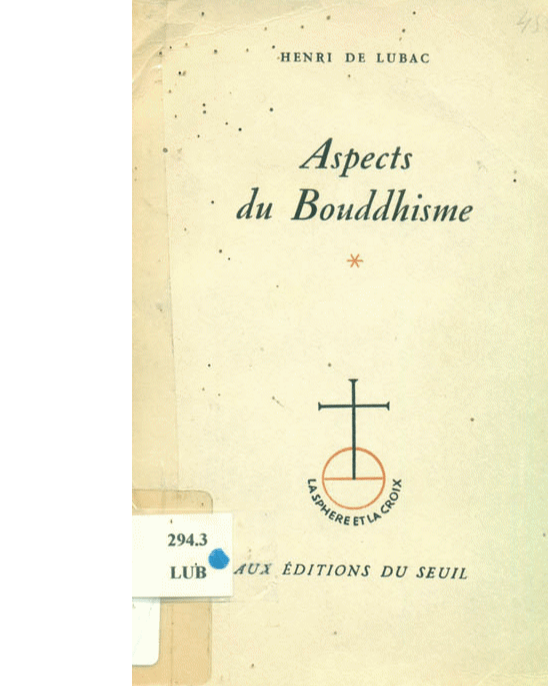
In 1951, noted Roman Catholic theologian, Henri de Lubac, published a small collection of essays entitled, Aspects du Bouddhisme [Aspects of Buddhism]. 1 Father de Lubac was one of a number of scholars who were part of a movement within twentieth century Roman Catholic theology called “ressourcement,” for which Patricia Kelly offers the following overview:
Ressourcement theology is the name given to the work of a number of French theologians, who were active from the interwar period until and including the Second Vatican Council (1962-1965). These scholars – Dominicans including Marie-Dominique Chenu (1895-1990) and Yves Congar (1904-1995) … and Jesuits Henri de Lubac (1896-1991), Jean Danielou (1905-1974) and Henri Bouillard (1908-1981) … sought to ‘refresh’ Catholic theology by ‘retrieving’ or ‘returning to’ the sources of theology. 2
And Professor Kelly clarifies that to which these scholars hoped to return and which they hoped to retrieve as “the biblical, patristic, liturgical, and medieval texts which form the sources of Christian theology …” 3
The thinkers within the ressourcement movement received much criticism:
They were attacked by their theological opponents and censured by their Religious superiors for what was seen as their ‘new’ approach to Catholic theology, particularly as they were also suspected and accused of wanting to abandon the work of St Thomas Aquinas. 4
And in the summer of 1950, Father de Lubac was “removed from his position as professor” at the Catholic University of Lyon, and he “was not allowed to return to his post at the college until 1958, and everything he wrote during this time was heavily censored. 5 With a new religious superior, the exiled Jesuit decided how to use this period of censor: “Since theology was closed to me, we decided that I should write on Buddhism.” 6 But Father de Lubac’s scholarly engagement this other religious tradition did not begin in the early 1950’s:
De Lubac’s interest in Buddhism dates back to his arrival in Lyon as a professor of theology in his first year on the faculty [1929], he was asked by the dean to teach a course on the ‘history of religions’ that would eventually include lectures on the philosophy of religion …, comparative mysticism, and elements of Hinduism and Buddhism. De Lubac thought his dean’s request a dubious project, given his complete lack of training in Asian languages and the meager resources for Hinduism and Buddhism available to him in Lyon. In addition to what he found in the library, his friend, the Abbe Jules Monchanin (1895-1957), provided him with a translation of the Mahāyānasūtrālaṃkāra (attributed to Asanga, ca. 320-390.) … In the twenty-year period lasting from 1930-1950, de Lubac … published three articles on Buddhism: an essay comparing early Buddhist texts with early Christian neo-Platonic theological texts from Alexandria (1937), one on the iconography of the cosmic tree in Buddhist and Christian art (1945), and another on Buddhist and Christian ‘charity’ (1950). 7
It is these three articles that were published together by the French Jesuit in 1951 under the title Aspects du Bouddhisme.
Father de Lubac’s affinity and respect for Buddhism is evident in both in his scholarly engagement of the tradition’s texts and his personal reflective writings: “I had always been attracted to the study of Buddhism, which I consider to be the greatest human achievement, in terms of its originality, its multifaceted expansion through space and time, its spiritual depth.” 8
Endnotes
- English translation: Henri de Lubac, Aspects of Buddhism. Translated by George Lamb. London: Sheed and Ward, 1953. (See image of the cover of the original 1951 French edition of the Jesuit’s book below.) Introducing Father de Lubac, James Fredericks writes: “Henri de Lubac (1896-1991) was a French Jesuit Catholic priest. Seriously wounded during the First World War, he served as a daring operative in the French Resistance during the Second World War … Much less recognized and appreciated is the fact that he was an accomplished scholar of Buddhism, with a special interest in the teachings of the great founders of the Pure Land schools in Japan’s Kamakura period (1185-1333), Hōnen (1133-1212) and Shinran (1173-1263).” (James L. Fredericks, “A Hermeneutics of Grace: Henri de Lubac’s Reception of Hōnen and Shinran.” The Eastern Buddhist, vol. 48, no. 1, 2017, page 159.)
- Patricia Kelly, Ressourcement Theology: A Sourcebook. London: T&T Clark, 2021, page 1.
- Patricia Kelly, Ressourcement Theology: A Sourcebook. London: T&T Clark, 2021, page 3.
- Patricia Kelly, Ressourcement Theology: A Sourcebook. London: T&T Clark, 2021, page 1.
- This helpful summary of the complicated issues related to Father de Lubac’s censor were retrieved from a February 20, 2017 post on the website of the Irish Jesuits entitled simply, “Henri de Lubac.” Retrieved from: Jesuits Ireland Upon learning of the censor, Father de Lubac’s friend and follow-theologian, Hans Urs von Balthasar (1905 – 1988), writes to him: “Dear Friend, I could scarcely believe what you have written to me. It is upsetting, completely incomprehensive. Yet this is probably the form of martyrdom that must seal your work. You are already the victor; nothing will stop the continued influence of your ideas …. Do not lose courage, keep on working as though nothing has happened. So many friends surround you and want to help you.” (Quoted in Rudolf Voderholzer, Meet Henri de Lubac: His Life and Work. Translated by Michael J. Miller. San Francisco: Ignatius Press, page 73.)
- Quoted in Rudolf Voderholzer, Meet Henri de Lubac: His Life and Work. Translated by Michael J. Miller. San Francisco: Ignatius Press, page 75.
- James L. Fredericks, “A Hermeneutics of Grace: Henri de Lubac’s Reception of Hōnen and Shinran.” The Eastern Buddhist, vol. 48, no. 1, 2017, pages 160-161.
- Jérôme Ducor, “Les écrits d’Henri de Lubac sur le bouddhisme”. Les cahiers bouddhiques.” Paris: Université Bouddhique Européenne, 2007, (5), page 84. Original French: «J’avais toujours eu un certain attrait pour l’étude du bouddhisme, que je considère comme le plus grand fait humain, à la fois par son originalité, son expansion multiforme à travers l’espace et le temps, sa profondeur spirituelle». French to English translation through DeepL.
 Julian of Norwich and Other Tibetan Lamas
Leave a comment