Thus I indured till day, and by then was my body dead from the middes downward, as to my feeling. Then was I stered to be set upright, underlening with helpe, for to have the more fredom of my hart to be at Gods will, and thinke on God while me life woulde last. 1
After several days of suffering from sickness, Julian feels that her body is dead from the waist down. And, as she above depicts in the Long Text, she “was stered to be set upright.” This self-report was, as others have noted, given more detail in the Short Text: “Than was I stirrede to be sette upperrightes, lenande with clothes to my hede, for to have the mare fredome of my herte to be atte Goddes wille, and thinkinge on him whiles my life walde laste.” 2 As Hannah Lucas explains, we learn from these passages that Julian is “lifted into a seated position by her companions who … place clothes underneath her head” to assist her to remain in that posture and position. 3
Scholars Nicholas Watson and Jacqueline Jenkins associated this change in position with Julian’s physical condition: “The shift in Julian’s physical posture temporarily eases what seems to be a constriction in her chest.” 4 Here the scholars seem to be linking Julian’s words “to have the more fredom of my hart to …” to an apparent “constriction in her chest,” and this may well be an element of what is going on. However, there may be another element which is related to her spiritual practice. In Chapter 10 of his guide for an anchorite, The Form of Living, the hermit Richard Rolle writes:
The fifth request was: in what situation [state] people are best enabled to love God. My response: in [whatever] situation that happens to allow people to be in the greatest physical and spiritual repose and to be least preoccupied with any demands or concerns in this world; the reason is that the thought of the love of Jesus Christ, and of the [day] which lasts perpetually, requires external repose so that it may not be distracted by comings and goings and preoccupation with things of this world, and requires greater interior silence from the dangers of materialism and trivialities and worldly ideas. In particular, all those who love the life of contemplation seek repose of body and soul, the reason being, as a great doctor of the church has explained, that those who remain constantly in one place, not dashing about, but firmly established in the sweetness of the love of Christ, are indeed ‘the throne’ of God. And I have loved to sit, not as a penance, nor as a freakish eccentricity because I wanted people to talk about me, nor for any such motive, but simply because I knew that I loved God more effectively [þat I loued God more], and the consolation of love lasted longer [and langer lested with me confort of louue] than walking or standing or kneeling. This is because when sitting I am more relaxed, and my heart is most inclined upward, [and my hert most vpward.] 5
TM himself quotes from this passage in a teaching on the topic, “How to Meditate,” with the following introduction:
Naturally speaking, the best position for meditation is a seated one. The sitting position is favored by a certain type of contemplative, and a quotation from that charming fourteenth-century mystic, Richard Rolle, may be adduced in witness to this fact … 6
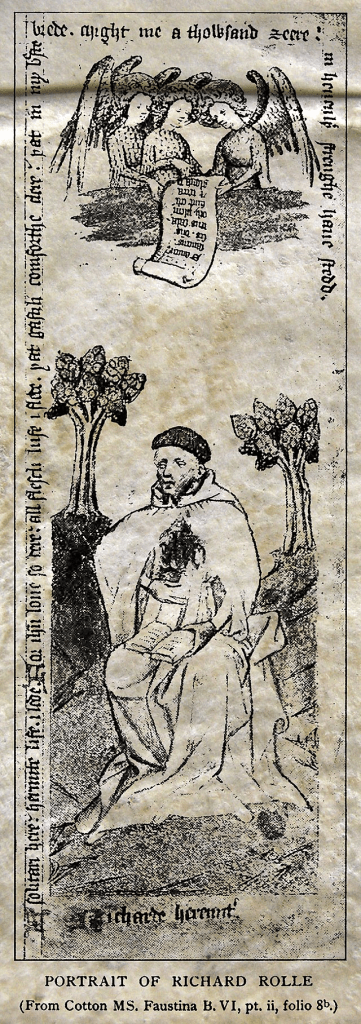
And scholar Rosamund Allen succinctly identifies the 14th century hermit with this posture: “Rolle always preferred to be seated in meditation.” 7
Richard Rolle’s practice and implied advocacy of sitting as a posture of meditation can help to provide a context for Julian’s desire to be reposited in her bed in order that she might have more freedom of heart and be better able to “think on” God. Scholar Christopher Roman writes:
Sitting for Rolle is a way to keep the body open to God. As he explains walking about or standing turns the body and, thus, the soul toward the world. Rolle appeals to Aristotle: ‘it is the quiet sitting that makes the soul wise.’ The sitting soul is quiet, stable. Rolle connects sitting to the ‘heights of contemplation.’ The ability to be in a humble, physical position allows the contemplative to reach greater spiritual heights. 8
Endnotes
- Julian of Norwich, The Writings of Julian of Norwich, Eds, Nicholas Watson and Jacqueline Jenkins. University Park, The Pennsylvania State University Press, Chapter 2, lines 15-19, and page 131.
- Julian of Norwich, The Writings of Julian of Norwich, Eds, Nicholas Watson and Jacqueline Jenkins. University Park, The Pennsylvania State University Press, Chapter 2, lines 17-19, and page 65. (Emphasis mine.) See B. A. Windeatt, “Julian of Norwich and Her Audience.” The Review of English Studies 28, no. 109 (1977), pages 1 and 2, regarding “the development of Julian’s understanding and presentation of her material during her lifetime” and the “omission” in what we are here calling the Long Text of “some vivid details of the events of [her] sickbed” that appear in what we are here calling the Short Text, which critics “generally accept” to be an “earlier work.” (Ibid.)
- Hannah Lucas, Julian of Norwich: A Phenomenology of Health and Home. Corpus Christi College University of Oxford A thesis submitted for the degree of Doctor of Philosophy, Trinity 2020, page 85.
- Julian of Norwich, The Writings of Julian of Norwich, Eds, Nicholas Watson and Jacqueline Jenkins. University Park, The Pennsylvania State University Press, page 130.
- “The Form of Living,” Richard Rolle: The English Writings. Translated, edited, and introduced by Rosamund S. Allen. New York: Paulist Press, 1988 pages 179-180. Extended Middle English quotation: “The v askynge was in what state men may moste loue God in. I answare: in what state so hit be þat men ben in moste reste of body and soule, and leste is occupied with any nedes or bisynesse of þis world. For þe þoght of þe loue of Ihesu Criste, and of þe day þat lesteth euer. Secheth reste withouten, þat hit be nat letted with comers and goers and occuoaciouns of worlder þynges; and hit secheth withinnen grete silence fro þe noyes of couetise and vanytees and erthly thoughtis. And namely al þat loloueth contemplative lif, þai seke rest in body and soule. For a gret doctor seith þat þay ben Goddis trone þat dwellen stille in a stid, and ben nat about rennynge, bot in swetnesse ofCristis loue be stabled. And I haue loued to sit, for no penaunce ne no fantasie ‘þat’ I wold men spake of me, ne for no such þynge, bot only for I knews þat I loued God more, and langer lested with me confort of louue, þan goynge or standynge or knelynge. For syttynge am I in most rest, and my hert most vpward. Bot þerfor peraduenture is hit nat þe best to anoþer to sit as I haue done, and wil do to my deth, bot if he were disposed as I was in his soule.” (“The Form of Living,” in Richard Rolle: Prose and Verse. Edited by S. J. Ogilvie-Thomson. Oxford, U.K.: The Early English Text Society – Oxford University Press, 1988, pages 23-24.)
- Thomas Merton, Spiritual Direction and Meditation. Collegeville: Liturgical Press, 1960, page 75.
- “Introduction,” Richard Rolle: The English Writings. Translated, edited, and introduced by Rosamund S. Allen. New York: Paulist Press, 1988 pages 179-180. See below for an image of a seated Richard Rolle, dating from the 1400’s. Retrieved from: File:Rolle Richard.jpg – Wikimedia Commons
- Christopher Roman, Queering Richard Rolle: Mystical Theology and the Hermit in Fourteenth Century England. New York: Palgrave MacMillan, 2017, page 76.
 Julian of Norwich and Other Tibetan Lamas

Leave a comment